


We’ve been busy since our last issue was published in the Fall! Read on to learn about a new report on menopause and SCI and a grad student investigating cardiovascular health for people living with SCI, meet our newest principal investigator and some award-winning trainees, and catch up on some interesting events. Plus, our regular features: help us do research, what’s new at ICORD-O, and Partner News!
We hope you enjoy these stories:
- A new report on menopause and SCI/D has been published
- Grad student investigates finger wrinkles and passive heating
- Meet our newest PI: Dr. Ashley Dalrymple
- Trainees who give back
- We’ve been busy: events roundup
And these regular columns:
Menopause & SCI/D priorities report published
by Pratyaksha Awasthi
ICORD PI Dr. Stacy Elliott, along with colleagues Kate McBride, Rachel Nicoletti, and Teri Thorson, recently published Menopause & Spinal Cord Injury: Co-creating priorities for clinical practice, research and knowledge translation. This report focuses on areas that people who experience menstruation and spinal cord injury and disease (SCI/D) and healthcare professionals in the field alike want to see prioritized.
Menopause – the end to menstruation and fertility – affects roughly half of the population and is an emerging field in health research. On its own, menopause comes with a host of physiological and mental changes that impact overall health and wellbeing, and these changes can intersect with conditions people with SCI/D are already experiencing. For example, osteoporosis (a disorder that is characterized by brittle, weak bones with lower bone mass) is common among both individuals with SCI/D and post-menopausal individuals; furthering the risk for people who fall into both categories. Interest in how menopause and SCI/D interact is growing; especially as life-expectancy for people with SCI/D increases.
As a response, a Menopause & SCI/D Collaborative was formed last summer, with the goal of identifying the top 10 questions people with SCI/D and their care professionals have about the topic. Inspired and led by women, the project not only helped generate the priority list, but also brought participants together. “The discussions in the smaller groups were great and very productive,” said one participant about the session. “We were hearing each other and making changes as we went and feeling good about them.” Another participant described the workshop experience as “informative, energizing, and inspiring.”
Project co-investigator Teri Thorson shared how, despite its immense impact on people’s wellness, menopause has been near-invisible in SCI/D research and care. “I hope clinicians and researchers see this report as a call to listen more closely to lived experience and to recognize menopause as a critical phase that deserves tailored, proactive support,” she added.
“We have a menopause momentum,” said co-investigator Kate McBride, adding that the process was very meaningful. “With the formation of a BC Menopause & SCI/D Collaborative, this discourse will continue and, hopefully, inspire others and create opportunities for new research, knowledge translation, and care initiatives informed by these priorities!”
Read the report here!
Stefan Vukovic investigates:
Hot tubs, finger wrinkles, and machine learning
by Jocelyn Chan
If you have ever stayed in the bath too long, you are probably familiar with “wrinkly” fingers. But did you know that this seemingly simple response is controlled by your nervous system? Stefan Vukovic, a master of science student in Dr. Victoria Claydon’s Cardiovascular Physiology Lab at SFU, is hoping to leverage this phenomenon along with the soothing heat of a hot tub to transform cardiovascular health and autonomic testing for people living with spinal cord injury.
Stefan first joined the lab during his BSc Honours in Kinesiology at SFU to validate wearable sensors for real-world measurement of cardiovascular responses, and he continued with the lab for his graduate studies. Supported by an ICORD Seed Grant, his current MSc research is a collaborative team effort alongside fellow ICORDians Jaimie Borisoff, James Laskin, and Maureen McGrath.
 The first part of his project explores full-body passive heat therapy, which involves sitting shoulder-deep in a hot tub for up to 45 minutes. By continuously tracking cardiovascular, respiratory, and thermoregulatory responses, the research team is investigating whether passive heat can mimic the physical benefits of exercise. “Our goal is to improve the accessibility of cardiovascular conditioning for people with SCI, particularly those who may have limited exercise capacities, to help reduce their risk of cardiovascular and metabolic diseases,” Stefan explained. The second part of Stefan’s project looks closely at the science of skin wrinkling of the fingers and toes.
Stefan with his research poster at the ICORD Trainee Symposium
While most people assume wrinkling is just water absorbing into the skin, it is actually triggered by blood vessels constricting, which is a process regulated by sympathetic nerve fibers.
“The thing that surprises people most often is finding out that finger wrinkling depends on the autonomic nervous system,” said Stefan. “There are fascinating cases where someone with a nerve injury to part of their finger experiences normal wrinkling on the healthy side, but the injured side stays completely smooth.”
While skin wrinkling has been used to detect nerve impairment in other conditions, it has never been studied in SCI. Stefan is taking photographs of water-induced wrinkles to train a machine-learning application that can automatically calculate the degree of wrinkling. The ultimate goal is to create a simple, inexpensive, and objective tool that clinicians can use to map a patient’s residual nerve function. Outside of the lab, Stefan describes himself as someone who loves getting used to the feeling of being a beginner and trying new things. He is a longtime soccer player, a skateboarder, a guitar player, and enjoys building things for both functional and artistic purposes. “The saying, ‘jack of all trades, master of none’ is a bit played out. Challenging myself to explore new opportunities has allowed me to develop skillsets I never would have otherwise explored!”
Want to participate in this study?
 Dr. Claydon’s team is actively recruiting participants with a spinal cord injury for this study.
What’s involved: A 2-hour testing session involving non-invasive monitoring and water immersion.
Get in touch: If you are interested in participating or learning more, please visit the study page for more information and the study contact.
New PI awarded CRC & CFI
Early in the new year, ICORD happily welcomed Dr. Ashley Dalrymple as a new Principal Investigator and Assistant Professor in the UBC Department of Physical Therapy, and now Dr. Dalrymple has been honoured with significant awards. 
Dr. Dalrymple is the Director of the Neural Engineering and Rehabilitation Via Electrical Stimulation (NERVES) Lab, an interdisciplinary research group focused on using electrical stimulation and neural interfaces to improve sensorimotor function after neural injury. Her work combines engineering, neuroscience, computing science, and rehabilitation to improve walking, restore sensation, and reduce pain through both preclinical and clinical studies. Her research spans neural interfaces, rehabilitation of walking, sensorimotor control, neuromodulation, and reinforcement learning. Dr. Dalrymple has worked extensively with spinal cord stimulation, implanted neural interfaces, and machine learning approaches to improve control of movement and reduce neuropathic and phantom limb pain. Her work bridges exploratory, preclinical, and clinical research to better understand how neural interfaces interact with the nervous system and how they can be used to restore function after injury.
Recently, Dr. Dalrymple was awarded a Tier 2 Canada Research Chair in Spinal Cord Neuromodulation as well as a Canada Foundation for Innovation John R. Evans Leadership Fund award for her project, Spinal Neuromodulation for Pain and Sensorimotor Function.
To learn more about Dr. Dalrymple, see this news story or her personal website.
Meet this year’s Trainee Award winners!
Trainee Awards are intended to recognize attributes – beyond excellence in publications and presentations – that make a trainee or scientist outstanding. The awards highlight achievements in work in the SCI community, mentoring of trainees, and service to others. The Gabriel Dix SCI Community Award honours individuals actively making a difference in the lives of people living with SCI. This year’s award was presented to Nathan Adams. Since joining the SCI Action Canada lab in 2022, Nathan has immersed himself in the local SCI community, moving well beyond professional engagement to meaningful community involvement. For the past four years, Nathan has been a dedicated member of the Kelowna Thunder Wheelchair Basketball Team. In addition, he volunteers with the local wheelchair rugby team, supporting local events and strengthening the broader adapted sports community. Through his consistent involvement he makes a difference in the lives of people living with SCI. This award is named for Gabriel Dix, a former trainee and staff member in the Martin Ginis Lab before his death in 2021.
The Wolfram Tetzlaff Mentorship Award acknowledges postdocs and PhD students who consistently go above and beyond to guide and support trainees. The award acknowledges the hard work and dedication of these mentors to make students feel supported and encouraged. This year, two trainees share this award. Congratulations to Dr. Mathew Debenham of the Berger Lab, and Dr. Timo Friedman of the Hilton Lab!
 Mathew Debenham is an exceptional mentor whose dedication has shaped the success of many trainees in the Berger Lab and across ICORD. Known for his thoughtful, question-driven approach, he challenges students to think critically while providing constant encouragement and support through every stage of their research—from project design and data collection to manuscript writing and thesis defenses. Despite the demanding workload of a postdoctoral fellow, Mathew generously gives his time to mentor trainees within and beyond his own lab, offering feedback, practical guidance, and career advice while fostering an environment where learning and collaboration thrive. His passion for spinal cord injury research, commitment to trainee well-being, and remarkable generosity make him a cornerstone of the lab community and a truly deserving recipient of this award.
 Timo Friedman is an outstanding mentor in the Hilton Lab whose generosity, patience, and deep expertise make him an invaluable resource for trainees. He is known for his ability to break down complex computational and analytical methods into clear, manageable steps, empowering students—especially those new to quantitative research—to confidently engage with their data. Timo consistently goes above and beyond to support graduate and undergraduate trainees through experimental design, data analysis, writing, presentations, and career development, often setting aside dedicated time to answer questions and troubleshoot challenges. His thoughtful feedback, collaborative spirit, and genuine investment in every trainee’s success foster a supportive and intellectually vibrant environment, making him a trusted guide and inspiring mentor across the lab community.
 The ICORD Trainee Outstanding Service Award recognizes trainees who have made outstanding contributions to the ICORD community. This year’s award was presented to Dr. Alanna Shwed, a postdoctoral fellow in Dr. Heather Gainforth’s lab. Alanna has shown an unwavering dedication to ICORD throughout her PhD and post-doctoral studies. Alanna’s dissertation and post-doc research directly advance meaningful engagement within ICORD and have led to tangible changes here. However, it is her commitment to ICORD beyond her research that exemplifies her impact and outstanding service. Alanna has served as a mentor and coordinator for the seed2STEM program at UBCO since 2022. To date, Alanna has been involved in supporting 50 students in the program and has been integral to advancing the program in the Okanagan. Alanna co-led the SSHRC-funded ICORD Spinal Cord Injury Research Partnership Workshop, which led to the creation of ICORD’s first Meaningful Engagement Committee on which Alanna has served. Her commitment to serving ICORD beyond her research goals is outstanding and has supported transformation within ICORD for years to come.
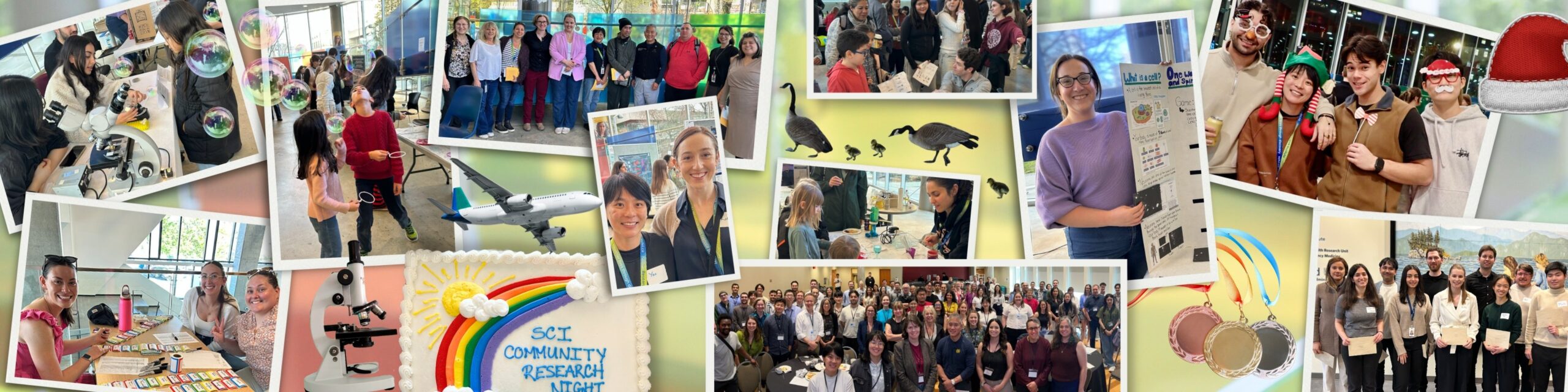
We’ve been busy!
Check out these ICORD events that have taken place since the Fall ICORDian was published! Read on for a quick recap (and click on the image above to see a full-sized version of the collage).
Celebration of the UN International Day for Women and Girls in Science
February 11
More than 100 guests, including lots of young children, had fun with interactive displays and activities by Science World, UBC Geering Up, ethós labs, Gynecologic Cancer Initiative, UBC Young Women for STEM, seed2STEM, and the Tetzlaff Lab, Hilton Lab, Moraes Lab, and OIBG from ICORD. We are grateful to Drs. Lynn Raymond and Shernaz Bamji, Co-Directors of the Djavad Mowafagian Centre for Brain Health, for their inspiring opening comments.

If you missed the event, you can still enjoy this online photo series of women of ICORD when they were future scientists.
Trainee symposium
March 10
Organized and presented entirely by members of the ICORD Trainee Committee, the 2026 Trainee Symposium took place on  March 10. Trainees Dr. Daniele Ferrari, Kenneth Wong, Isa Samad, Nicholas Tjandra, Dr. Tara Fortino, and Nikolai Lesack gave informative talks about their current research. Dr. Freda Miller, Tova Plashkes, and Matt Jensen shared stories about their professional career paths, and new ICORD PIs Drs. Chris Moraes, Femke Hoekstra, Ashley Dalrymple, and Zhenwei Ma spoke about their work. Ryan Clarkson and Matthew Querée gave talks from the SCI community perspective following 28 research poster presentations. It was a fun and inspiring day! Congratulations to symposium co-chairs, Yao Sun and Katie Jeffris (right) for their organizational success!
Staff appreciation coffee break
April 9
Did you know that, between them, ICORD staff members have more than 460 years of service to UBC? That’s a huge amount of institutional knowledge! On April 9, Director Dr. Brian Kwon recognized a group of ICORD staff members who have reached milestones in their service to UBC: Milly Zaletelj, Katie Ashwell, and Jay Ethridge (5 years’ service); Kevin Dong, Andrea Maharaj, Karen Jung, and Liz Raffaele (10 years), Xianghong Shan (15 years), and Chandelle Coleman and Cheryl Niamath (35 years!).
L-R: Chandelle, Liz, Milly, Katie, Xianghong, Kevin, Brian, Jay, Cheryl, Andrea (missing: Karen)
Science Mixer
April 15
 ICORDians based at the Blusson Spinal Cord Centre welcomed SFU faculty members Gustavo Balbinot, Carolyn Sparrey, and Victoria Claydon and their labs for our first Science Mixer! Following three interesting talks (Dr. Balbinot: Stem cells to repair hand function in cervical SCI; Dr. Sparrey: Models of SCI; Dr. Claydon: Autonomic consequences of SCI) everyone gathered in the atrium to talk research and make new connections.
Community Research Night and ICORD Retreat
May 11 + 12
More than 90 PIs, trainees, staff, and special guests met up at UBC Okanagan in Kelowna in early May to take part in a Community Research Night (May 11) and an ICORD retreat (May 12). The Community Research Night, organized by ICORD’s Meaningful Engagement Committee and attended by more than 120 researchers and community members, included information displays presented by Spinal Cord Injury BC, Accessible Okanagan, Praxis Spinal Cord Institute, Vernon Adaptive, and Adaptive Adventures, along with posters illustrating the type of research done in a wide variety of ICORD labs.
The morning session of the ICORD Retreat on May 12 saw 25 PIs and clinicians give 5-minute talks about their research programs (amazingly, finishing exactly on schedule). Most participants stayed on in Kelowna for the Canadian Spinal Cord Injury (CAN-SCI) meeting on May 13-14. 

Congratulations to Dr. Cameron Gee, whohas been awarded a 2-year postdoctoral fellowship through the Craig Neilsen Foundation’s psychosocial research portfolio to conduct a set of studies exploring associations between exercise, neuropathic pain, and mood in people with spinal cord injury. This research will be conducted in Dr. Kathleen Martin Ginis’ SCI Action Canada Lab at UBC Okanagan, and in collaboration with Drs. Andrea Bundon and Kip Kramer in Vancouver.
Help us do research
Interested in helping ICORD researchers make SCI preventable, livable, and curable? These research studies (and more) are in need of participants!curable? These research studies (and more) are in need of participants!
 Biomaterials to treat spinal cord injury
Researchers on the Mend the Gap team would like to hear about your expectations and risk tolerances for a novel intervention involving a combination of drugs and an injectable biomaterial that is intended to help nerves regrow in the spinal cord and improve functional outcome, so that development continues and dissemination steps are undertaken in ways that are best aligned with the priorities of the spinal cord injury community. Read more . . . Measuring daily face exposure using wearable cameras
Dr. Ipek Oruc’s team is evaluating how the human brain processes daily exposure to faces. Participants aged 19+ with normal or corrected-to-normal vision will wear a head-mounted camera that takes first-person photographs at regular intervals during a single 2-hour session. Read More…Robust visual recognition of high-level form in human observers
Dr. Ipek Oruc’s team is investigating how the human brain recognizes faces and visual objects. Participants aged 19+ with normal or corrected-to-normal vision will complete an online test assessing their ability to differentiate similar faces. Read More…Potential benefits of passive heating (hot tub) on your health – A pilot study
Drs. Jaimie Borisoff and Victoria Claydon are studying whether sitting in a hot tub can safely provide exercise-like cardiovascular benefits. Healthy individuals aged 19+ with an SCI between T7 and C4 will participate in a single 3-to-4 hour session at SFU involving physiological monitoring before, during, and after hot water immersion. Read More… Effects of rhythmic exercise on pelvic floor activity
Dr. Tania Lam’s lab is investigating how upper-body rhythmic exercises, such as arm cycling and ski ergometry, affect pelvic floor muscle activity. Participants aged 19+ with a stable spinal cord injury at or above the L1 level will complete a single 3-to-4 hour laboratory session to explore alternative physical therapy approaches for bladder and bowel health. Read More… Can regular use of a standing frame combined with nerve stimulation improve bladder function?
Dr. Tania Lam’s team is studying whether combining electrical ankle stimulation with standing therapy can improve bladder symptoms by activating neural links between the legs and bladder. Read More… Usability of a novel alternative to the universal cuff:
the OmniCuff
Dr. Ben Mortenson’s team is evaluating how a new assistive device called the OmniCuff impacts daily activities and independence for individuals with limited hand function. Participants will trial the device at home for two weeks and participate in two in-person home visits for training and interviews. Read More…
Click here to browse all the ICORD studies currently recruiting participants.
Interested in participating in ICORD research but feeling overwhelmed by the number of studies?
Our Study Liaison is here to help!
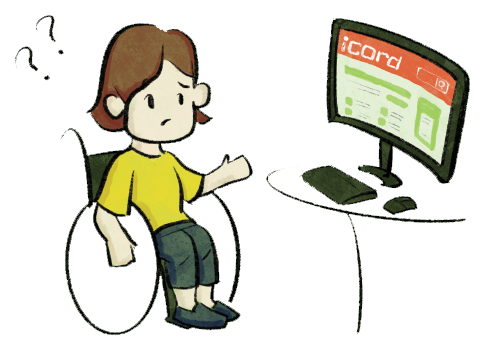 Interested in participating in ICORD research but feeling overwhelmed by the number of studies? Meet our study liaison, Winston Brandt! He will work with you to narrow down what studies you may be eligible for. Over a few short phone calls, he will ask you questions about your research interests as well as common study inclusion and exclusion criteria. From there he will tailor a list of research studies for you and provide details and contact information for each one. He can also directly connect you with study coordinators if you like. Send him an email to begin your consultation!
Partner news

SCI Nav launched
A new spinal cord injury navigation service (SCI Nav) is now available to people living with SCI, their families, caregivers, and clinicians in BC and Yukon. Funded and guided by the Rick Hansen Foundation, with input from SCI BC and support from VGH & UBC Hospital Foundation, SCI Nav is led by a specialized team at G.F. Strong. Read more about this new service here.

New primary care & sexual health resources from SCIRE
SCIRE has launched a new suite of primary care resources designed for both clinicians and individuals living with SCI.
- Clinical Guidance: Access specialized sections covering clinical guidance in Blood Pressure, Respiratory, Cardiovascular, Bowel, Bladder, and Skin Health.
- Accredited Training: Free online courses are now available for general practitioners to help optimize care for patients with SCI.
- Patient Resources: Download the new Working with your Primary Care Provider Factsheet from SCIRE Community
Great news for BC clinicians: all of these new materials are now live and searchable directly within Pathways BC, making it easy to access clinical guidance and email resources directly to patients during a consult.
SCIRE has also fully updated their Sexual and Reproductive Health after SCI Resources.
For more updates, follow SCIRE Community on Facebook, X, and LinkedIn, and SCIRE Professional on X and LinkedIn.
 Upcoming events
On June 5, VCHRI will be holding an in-person trainee career day at the Blusson Spinal Cord Centre.
On June 23, VCHRI will be hosting their first in-person “Lunch and Unlearning” Gathering as part of their new initiative, the Unlearning Club. The Unlearning Club is a focused on fostering dialogue on Indigenous-specific racism. Click here to learn more or to register.
 Thanks for reading this issue of The ICORDian – we hope you enjoyed it! Please subscribe and have future issues delivered to your inbox. If you have any comments about this issue or suggestions for future ones, please contact us.


Jocelyn Chan, Kate McBride, Stefan Vukovic, Victoria Claydon, Pratyaksha Awasthi, Katie Ashwell, and Cheryl Niamath for their contributions to this issue of our newsletter. This will be Jocelyn’s last issue of the ICORDian. Medical school is taking up most of her time these days, and she is leaving the Communications team after eight fun and productive years. We are tremendously grateful
for all her help with our newsletter, website, social media, events, and annual reports. A warm welcome to Pratyaksha Awasthi, ICORD’s new Knowledge Translation and Communications Assistant. Praty wrote this issue’s article on the menopause and SCI report, and created the collage of photos from events that have happened since our last issue. We look forward to working with her!